
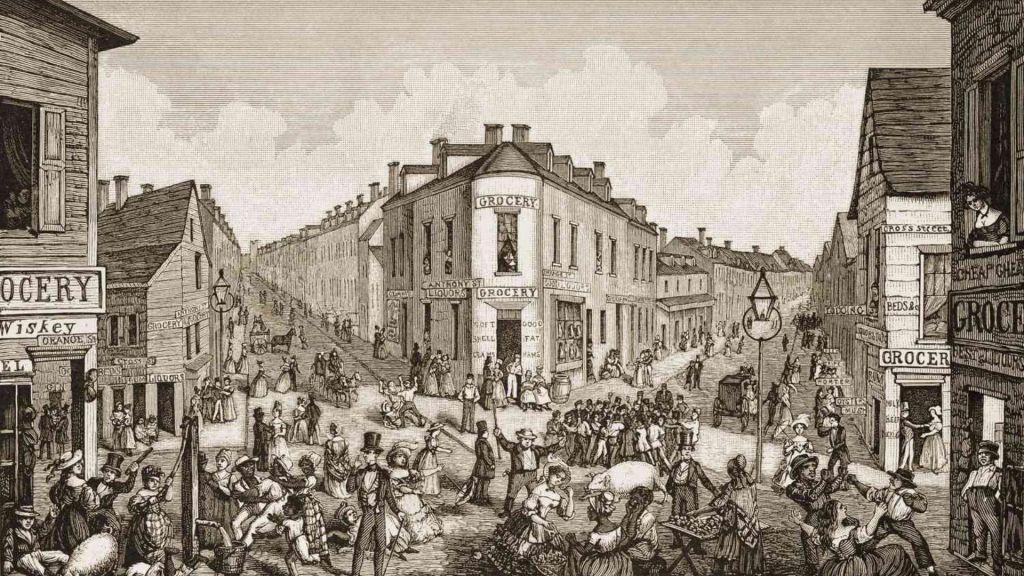
In the late 19th century, Troy, New York, was a city defined by cobblestone streets, burgeoning industry, and typical small-town affairs. Yet, beneath this veneer of normalcy, a story unfolded that would both shock its residents and confound medical professionals: the story of Retta McCabe, a cherubic child harboring a sinister secret.
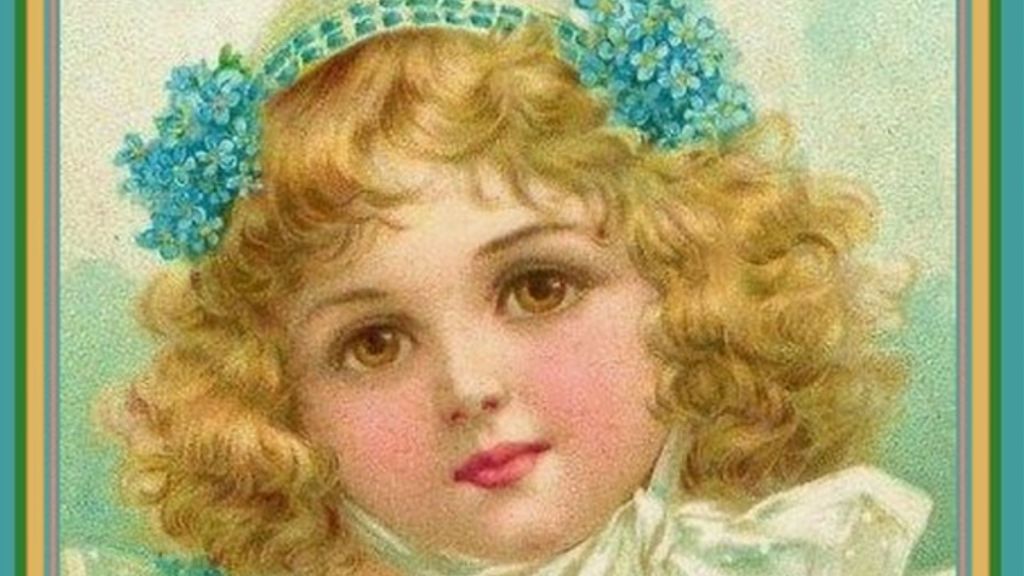
Retta appeared like any other child: a golden-haired beauty with dazzling blue eyes, emitting the infectious laughter of youth. However, in an instant, this joyful child could transform into something far more sinister—something dark and terrifying. This wasn’t an occasional tantrum or simple mischief; as many attested, it was as though the devil himself briefly possessed her.
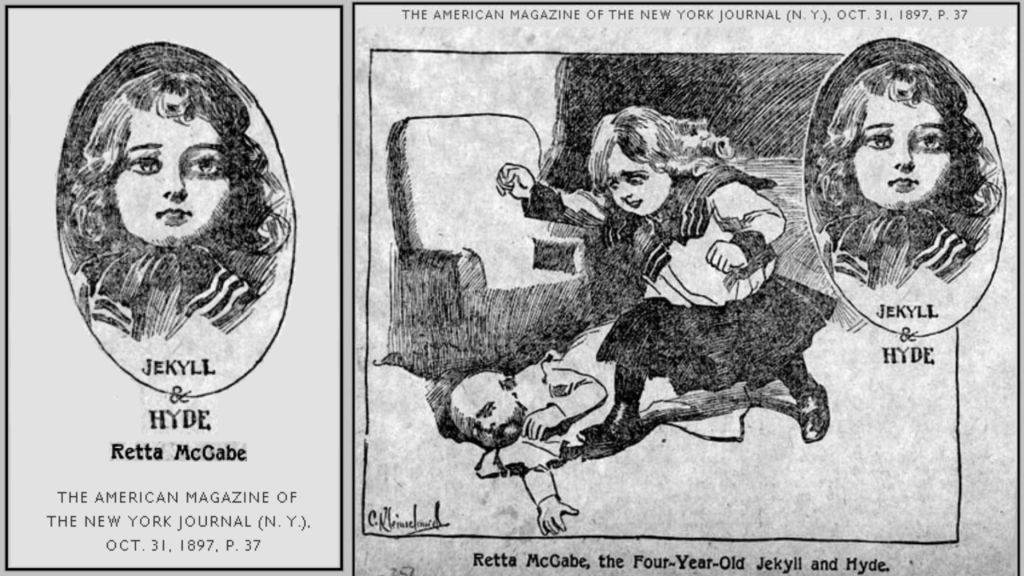
One fateful day, tragedy struck at the heart of the McCabe household. Toys scattered, and parents went about their chores when Retta abruptly rose from her playful position on the floor. Without warning or apparent reason, she seized her infant brother, her tiny arms encircling the unsuspecting child, and flung him to the ground. The room resounded with a sickening thud. Before any aid could reach the infant, Retta descended upon him, stomping and pounding on her defenseless brother. When they finally managed to pull her away, her slight frame trembled, and her eyes were ablaze. A week later, as the life left her battered infant sibling, Retta’s laughter resounded. She laughed as if she’d just heard the world’s funniest joke.
However, the horror extended beyond her home’s confines. On a fateful afternoon at the bustling Union Station, Retta starred in a public spectacle of alarming proportions. Amidst chugging trains and bustling passengers, Retta positioned herself defiantly on the tracks, gazing down at the approaching iron behemoths. Women watching the scene shrieked in terror, some even fainting, as they beheld this young girl, a smile on her face, daring the specter of death. A courageous soul eventually dragged her away, but she morphed once more into that uncontrollable force. She screamed, bit, and fought like a caged animal. The police officer, accustomed to handling hardened criminals, had to subdue her multiple times, fearing the havoc her thrashing might wreak.
She was an enigma that defied resolution. At the police precinct, Retta was considered too perilous for conventional containment. Behind cold iron bars, she exhibited both sides of her bewildering persona. Initially, she tore at her beautiful locks, shrieking and ranting. Yet, soon after, like the passing of a storm, she reverted to that sunny little girl—her eyes aglinting with innocence, her smile just as enchanting.
The question on everyone’s lips was identical: What had engendered this duality in Retta? Was it something internal, a demon locked in a struggle for control, or a reflection of external torment? The city held its breath, seeking answers, while the chronicle of Retta McCabe, the child embodying Jekyll and Hyde, continued to unfold.
The Mystery of Retta’s Dual Personality
In the aftermath of the traumatic events at the precinct, officers found themselves in a dilemma. The legal system of the era lacked provisions for addressing a child as young as Retta. Incarceration in institutions was only permissible after the age of seven, and Retta, a mere four years old, slipped through the cracks of an unprepared system.
Transferred to the custody of the Humane Society, officials aimed to provide a more nurturing environment, devoid of austere iron bars. However, the tranquility was short-lived. No sooner had Retta stepped outside than she evaded her custodian, fixated on burned matchsticks scattered across the pavement. It was as though each tiny, charred fragment held an enigmatic allure, drawing her in akin to a moth to a flame.
Retta’s peculiarities did not cease there. Inside the Humane Society’s premises, her energy transformed into a different manifestation—acrobatics. With an agility that would have astounded a professional performer, let alone a four-year-old, Retta executed handsprings with astounding precision. She moved gracefully, flipping and tumbling, until an ill-judged leap propelled her into a wall. Even as the matron approached with concern, attempting to provide solace, Retta’s Jekyll side surfaced. She bit into the matron’s arm, drawing blood and rekindling the ever-present terror that shadowed her.
Yet, amidst these chilling episodes, glimpses of the ‘normal’ Retta shone through. In moments of calm, one could discern a child reveling in play, basking in the joy of discovery, and beholding the world with wide-eyed wonder. However, these instances were fleeting. Soon, she would chase other children, not in playful pursuit but with malevolent intent, inserting buttons and beans into their ears and nostrils, as if enacting some macabre ritual.
The Humane Society was at a loss. Returning her to her parents appeared to be the most humane choice. Yet her reputation preceded her. Reports of her terrorizing neighborhood children had spread rapidly, and an undeniable fear had set in. Parents clung tightly to their children when Retta was near, and murmurs of the ‘demonic child’ circulated in hushed tones throughout the town.
Medical professionals and psychologists of the era, hampered by the knowledge and tools of their time, grappled with diagnosing or comprehending Retta’s condition. Some posited possession, while others theorized about early signs of psychopathy; still, others surmised she might be responding to deeply rooted trauma. However, no definitive answers surfaced.
As the town wrestled with the puzzle of Retta McCabe, a more overarching query loomed: How does one aid a child ensnared between the realms of an angel and a demon? What remedy could society offer to a riddle that defied elucidation?
Her Disappearance and Legacy
With Troy in a state of unease, Retta McCabe’s presence began to influence more than immediate circumstances; it started shaping discussions, apprehensions, and the very fabric of societal norms. The notion of a child manifesting such violent tendencies was unfamiliar and unsettling, prompting the question: How does society handle the inexplicable?
The McCabe family, burdened by furtive glances and whispered conversations, found themselves in an untenable position. Retaining Retta at home seemed perilous, yet no institution appeared equipped to address her distinctive requirements. Parents across town had understandably grown cautious, instructing their children to steer clear of the young McCabe girl. The cherished innocence of childhood, often taken for granted, has been usurped by a cautionary tale.
Amidst this turmoil, a shadowy turn of events unfolded—Retta vanished. The suddenness and mystique surrounding her disappearance further fueled wild speculations. Had her family, in a desperate act, spirited her away? Did the town, in an effort to safeguard itself, play a role in her vanishing? Alternatively, had Retta, in a final act of rebellion or escape, managed to break free from it all?
Decades later, in 1934, a glimmer of hope emerged. A classified advertisement surfaced, placed by Retta’s parents’ lawyer. It was a plea, a quest for any trace of their missing daughter. Yet the hope dissipated as swiftly as it had arisen. The trail grew cold, and no subsequent records of Retta McCabe were discovered.
Nevertheless, Retta’s narrative remains profoundly etched in the chronicles of true crime. It stands as a haunting reminder of the intricacies of the human psyche and the limitations of societal comprehension. She serves as a symbol of the blurred demarcation between innocence and malevolence, challenging conventional notions of nature versus nurture.


 Deep Lore