

Our tale begins with an ominous figure of early 19th-century American history: Lavinia Fisher. The contours of her life and alleged misdeeds have since been shrouded in the mists of urban legend, and she has been posthumously dubbed the first female serial killer of the United States. While this moniker is undoubtedly chilling, it is also subject to ongoing historical debate, a testament to the enigmatic nature of Lavinia Fisher and her place in the annals of crime.
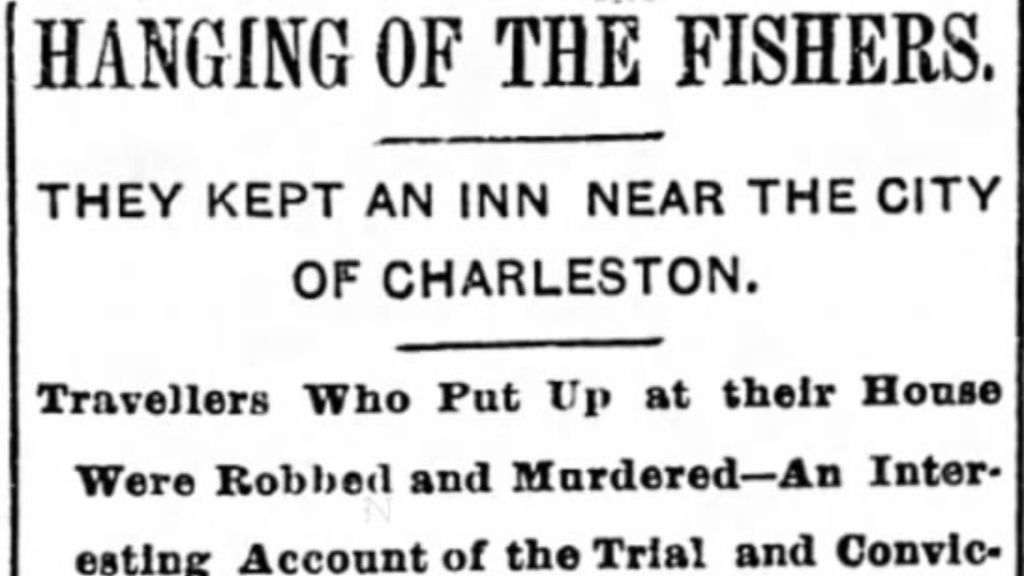
Born in 1793, Lavinia lived most of her life in Charleston, South Carolina, alongside her husband, John Fisher. Both were convicted of highway robbery, a crime deemed severe enough to warrant capital punishment during their era. However, it is essential to note that they were not formally charged with murder. This peculiar discrepancy between their crimes and their public image forms the crux of the Lavinia Fisher legend.
Despite the absence of concrete evidence tying Lavinia to any homicides, she was nonetheless associated with a notorious network of outlaws. Along with her husband, Lavinia was an active member of a large gang of highwaymen. This feared group had its roots and operations deeply entrenched in the backcountry near Charleston. Their criminal activities primarily emanated from two hideouts, ominously referred to as the Five Mile House and the Six Mile House. The latter’s exact function remains murky to this day, with conjectures ranging from it being a hotel to a hub for a motley crew of outlaws.
The Fishers weren’t just involved in illicit activities; they also owned a seemingly legitimate business, an inn named the Six Mile Wayfarer House. Their enterprise was located six miles north of Charleston, hence the name. Under their management in the early 19th century, the inn developed a reputation for welcoming travelers—some of whom would mysteriously vanish. Complaints about these inexplicable disappearances eventually reached the local sheriff, but the Fishers’ deep-rooted popularity with the locals and a lack of concrete evidence against them ensured these grievances went unresolved.
Thus begins the saga of Lavinia Fisher, an enigma wrapped in controversy and dispute. She represents a fascinating intersection of fact and fiction, and her story brings us face to face with our innate fascination with true crime and the allure of legends.

The Crimes
The ambiguity and intrigue surrounding Lavinia Fisher only grew with tales of the gruesome crimes allegedly committed at the Six Mile Wayfarer House. As the legend goes, Lavinia would engage lone travelers at her inn with warm hospitality and probing conversations. She was interested in their occupations, a discreet tactic to ascertain their financial standing, and the potential loot they carried.
Upon ascertaining their worth, Lavinia would dispatch her unsuspecting victims to their rooms, handing them a cup of poisoned tea. After the hapless guests drank their tea and retired to bed, John Fisher would reportedly enter their rooms and viciously assault them, stopping just shy of murder.
However, a different, even more sinister version of the story persists. This iteration suggests that Lavinia’s tea only induced sleep for a few hours. As the travelers were lulled into a slumberous state, Lavinia would activate a lever, causing the bed to collapse and drop the victim into a pit, potentially bristling with spikes.
Over the years, the truth behind these alleged murders has been embellished, distorted, and lost to the sands of time, making factual details challenging to ascertain. What is known, however, is that in February 1819, the local Charleston Post and Courier reported on a vigilante gang that intended to end the rampant gang activities attributed to the Fishers and their associates.
Leaving a young man named David Ross as a sentinel, the vigilantes believed they had achieved their objective and departed. The following day, Ross was assaulted by two men and brought before the infamous gang. Lavinia Fisher was among them, and rather than offering him assistance, she reportedly choked Ross and smashed his head through a window. Despite this horrific ordeal, Ross managed to escape and alert the authorities.
In the immediate aftermath of this incident, a traveler named John Peeples sought lodging at the inn. Lavinia, maintaining her facade of warm hospitality, welcomed him in for tea and conversation despite not having a room to offer. John, suspicious of the prolonged interrogation and the circumstances, opted to sleep in a chair near the door. His suspicions were confirmed when he woke to the sound of the bed collapsing, revealing the lethal trap beneath.
Barely escaping with his life, Peeples rode to Charleston to alert the authorities about the Fishers’ deadly scheme. With two firsthand accounts now against them, law enforcement finally had the names of the perpetrators they had been seeking. The tales of hospitality turned horrifying, as well as the Fishers’ associations with highway robbery, set the stage for a reckoning that had been a long time coming.

The Investigation, Arrest, and Trial
Upon receiving the two eyewitness accounts, the police were able to identify the alleged assailants. A police force was dispatched to the Six Mile Wayfarer House, where the investigation into the nefarious Fishers began in earnest. The authorities were able to locate John and Lavinia Fisher along with two other members of their gang. It was John who surrendered the group, in a bid to shield his wife, Lavinia, from potential gunfire.
During the subsequent interrogation, John attempted to protect Lavinia again, revealing the identities of all those involved in their gang activities. His efforts would, however, prove futile. After their arrest, nearly a year elapsed before their execution. Despite their pleas of innocence, they were found guilty of highway robbery, a capital offense at the time, and ordered to stay in jail until their trial in May. Their co-conspirators, however, were released on bail.
Held together in a small cell at the Old City Jail in Charleston, South Carolina, the Fishers plotted an escape. On September 13, they made their move, but their plan went awry when the rope made from prison linens broke, leaving Lavinia behind while John was momentarily free. Unwilling to abandon his wife, John was swiftly recaptured, and the pair were subsequently held under stricter security.
In a turn of events that seemed to seal their fate, their appeal was rejected by the Constitutional court. On February 4, 1820, both John and Lavinia Fisher were sentenced to hang. As they awaited execution, their behavior was markedly different. John accepted the counsel of the Reverend Richard Furman, a local minister, while Lavinia reportedly became more hostile.
On the day of their execution, a crowd of around 2,000 people gathered to witness their end. Reverend Furman read aloud a letter composed by John in which he maintained his innocence, even as he asked forgiveness from the crowd for any wrongdoing. Lavinia, however, clung to a belief in her impending pardon until the very end. Her final, chilling words to the crowd were a foreboding message to the devil, an utterance that would only serve to heighten the legend surrounding her.
The Legacy and the Legend
Lavinia Fisher, unlike her husband, believed that she would be pardoned right up until the moment she was executed. In a legendary proclamation, she used her final moments to deliver a haunting message, asking the gathered crowd to pass on any messages to the devil as she would be seeing him shortly. With these infamous words, she jumped off the gallows stand, essentially executing herself. The chilling nature of her execution, coupled with the grisly rumors surrounding her criminal activity, has led to the enduring urban legend that she was America’s first female serial killer.
Post-execution, the legend of Lavinia Fisher took on a life of its own. Some believe that her spirit haunts the Old Charleston Jail House where she was held. Sightings of her spectral apparition have been claimed by various tourists, adding an eerie dimension to the existing tales of her life and crimes.
As for her burial, Lavinia was interred in a potter’s field near the Old City Jail. However, erroneous claims promoted by tour guides suggest she was buried at either 150 Meeting Street, The Circular Congregational Church, or at 4 Archdale Street, The Unitarian Church. These discrepancies further contribute to the mystery and intrigue surrounding the life and death of Lavinia Fisher.
Over the years, the tales of Lavinia and John Fisher have been greatly exaggerated, their crimes embellished, and their punishment dramatized. Yet, at the heart of it, the story serves as a chilling reminder of a time when crime was rampant, justice was severe, and the line between fact and fiction often blurred. The legend of Lavinia Fisher, whether rooted in reality or fantasy, continues to captivate the public imagination, cementing her place in the annals of American crime history.


 Deep Lore