
On February 9, 2007, a garbled radio message broke through the static. “This is kayak one… I’ve got an emergency situation. I’m sinking. Do you copy?” There was a brief pause, a crackle of static, then silence. It was Andrew McAuley’s final transmission.
At that moment, Andrew was just 30 kilometers from the coast of New Zealand—so close to completing his dream: a solo, 1,000-mile kayak journey across the dangerous Tasman Sea. The message was unsettling, but no one believed things could have gone seriously wrong. After all, Andrew McAuley was no ordinary man. He was an adventurer, someone who had thrived in the world’s most dangerous places, a man who had lived his life pushing the boundaries of human endurance.
Born in Goulburn, New South Wales, Andrew’s adventurous spirit was evident from a young age. He was a mountaineer, a sea kayaker, a man who constantly sought out the extreme. By the time he was 38, he had already achieved things most people wouldn’t dare imagine: the first non-stop kayak crossing of the Bass Strait, an expedition across the Gulf of Carpentaria, and treacherous climbs in Pakistan and Patagonia. But the Tasman Sea—perhaps the wildest stretch of ocean between Australia and New Zealand—was his ultimate goal.
For nearly a decade, Andrew had been preparing for this moment. His custom-designed 19-foot kayak, a modified Mirage, was his lifeline. It had a small fiberglass capsule he called “Casper,” which allowed him to sleep inside, protected from the stormy sea. Andrew knew the risks: freak waves, freezing temperatures, and brutal gales. Still, he had spent years meticulously preparing for every possible scenario. He wasn’t reckless—he was calculated, determined. “It’s an excellent, excellent, excellent adventure,” he told a camera before setting off. “Provided I make it.”
On January 11, 2007, Andrew embarked on his second attempt at the crossing, after aborting an earlier try due to freezing conditions. For weeks, everything went according to plan. He sent regular updates to his wife, Vicki, and his team, describing the journey as exhilarating, though challenging. Each day brought him closer to New Zealand’s shores. He had survived a 27-hour storm, capsized multiple times, and always recovered. There were doubts—whispers in the adventure community about the dangers he faced—but Andrew seemed to have it under control.
Then, on February 9th, the final message came through: “I’m sinking.” And just like that, Andrew McAuley disappeared.
The Ocean Is A Vast and Untamed Place
Andrew had been so close. On February 8th, just a day before his disappearance, he had sent Vicki a message full of optimism: “See you 9 a.m. Sunday!” He was only hours from Milford Sound, where his family, friends, and fellow adventurers were gathering to celebrate. They had champagne ready, waiting for his triumphant arrival. But the next morning, Andrew didn’t arrive.
At first, there was no panic. Maybe he had run into some small trouble, but Andrew always found a way through. That evening, the New Zealand Coast Guard picked up a scrambled radio signal—barely audible. Initially, it seemed like a routine check-in from Andrew, but as the message was replayed, something more chilling emerged: the words “help” and “sinking” became clear.
The search began immediately. Planes scoured the waters near the New Zealand coast, hoping to spot Andrew’s kayak. For hours, there was no sign of him. Then, on the night of February 10th, search teams spotted his kayak—upturned but intact—just 34 miles offshore. It was eerily well-preserved. His paddle was inside. His emergency radio, his GPS, his satellite phone—all accounted for. But Andrew himself was gone.
What happened? How could an experienced kayaker disappear so close to safety? The more investigators looked, the stranger the case became. The kayak showed minimal damage. It hadn’t been destroyed by a wave. His gear was still functional, yet Andrew hadn’t triggered his emergency beacon.
Paul Hewitson, the designer of Andrew’s kayak, inspected the craft, searching for clues. He speculated that Andrew had capsized—something he had done before—but this time, the protective fiberglass cover, “Casper,” wasn’t in place. That cover was critical, shielding him from waves and allowing the kayak to self-right. Without it, Andrew would have been thrown into the sea. In rough conditions, re-entering the kayak would have been a grueling task, even for someone as skilled as Andrew. Hewitson believed that Andrew, possibly exhausted, may have struggled to right the kayak, eventually becoming separated from it.
But why hadn’t he activated the emergency beacon? Why, after surviving the worst storms, had Andrew lost control in relatively calm seas? These questions haunted his family and the investigators.

The Empty Kayak Remains
The search for Andrew McAuley continued for days, but there was no sign of him. On February 12th, three days after his final transmission, the official search was called off. For his family, for the community of adventurers who had followed his journey, it was an unbearable end. The ocean, it seemed, had claimed Andrew, just as he was on the verge of completing his greatest feat.
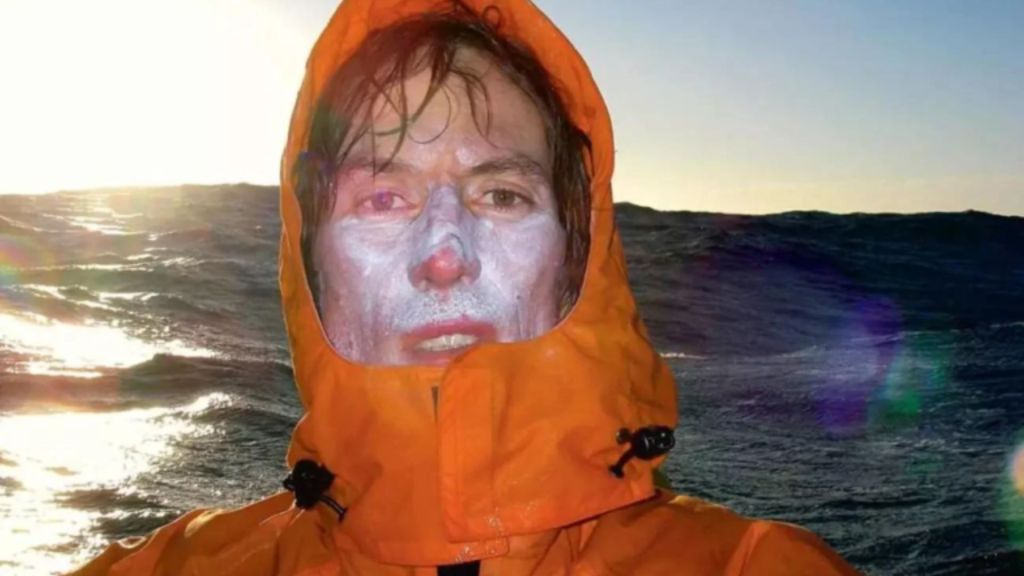
In the days that followed, more clues emerged, though none provided a definitive answer. Footage from Andrew’s camera was recovered. In one of his final videos, recorded in the calm before his disappearance, Andrew speaks to the camera with a haunting mix of excitement and exhaustion. “I may have bitten off more than I can chew,” he says, his face gaunt, eyes hollow after weeks of battling the sea.
What exactly happened in those last moments? Did a rogue wave knock him out of the kayak? Did he misjudge the conditions, letting his guard down when safety seemed so close? The investigators could only speculate. Some believed Andrew had removed his cockpit cover to access his dry suit or radio, moments before disaster struck. Others thought fatigue had simply gotten the better of him after weeks of constant exertion.
But the truth was—and remains—that no one really knows.
Andrew’s body was never found. His family, especially Vicki, has had to live with the ambiguity, the gnawing question of how things could have gone so wrong so close to the end. At a memorial service for Andrew, held on a cliff overlooking the Tasman Sea, 400 friends and family gathered to remember the man who lived for adventure, who constantly pushed the boundaries of what was possible.
In the end, Andrew McAuley’s disappearance became one of the Tasman Sea’s many mysteries. His ambition and skill had brought him to the edge of triumph, but the ocean had the final say. As Vicki reflected on his life and his need to explore, she quoted him: “Man cannot discover new oceans unless he has the courage to lose sight of the shore.”
Andrew had the courage. He lost sight of the shore. And somewhere, in the vast waters of the Tasman, he was lost as well.


 Deep Lore