

On the island of Saipan, the air stays warm long after midnight. The sea wind drifts through the open doors of Godfather’s Bar, carrying the sound of clinking bottles and laughter down Palm Street. On February 4, 2012, Emerita “Emie” Relata Romero was behind the counter as usual—thirty-seven years old, quiet, quick with a smile. She knew the regulars by their drinks and the tourists by how they tipped. The night ran like any other: beers poured, songs played, hands waved goodbye at closing time.
By three in the morning, the bar was empty. The floor smelled faintly of bleach. Emie clocked out, shoulders heavy, and joined two coworkers in a waiting taxi. They lived close together in Garapan, so they shared rides often—short trips through the quiet streets before the first light. The driver dropped off the first woman, then the second. Emie was last. She leaned her head against the window and told the driver she might fall asleep before they got there.
When she stepped out near her apartment, she was ready for bed. Then her phone rang. One of the coworkers had realized their bags had been switched in the taxi. Emie told her they could fix it in the morning; she was exhausted. But the coworker insisted—she needed her things now. So Emie agreed, reluctantly, and went back outside.
A few minutes later, the coworker arrived. They exchanged the bags quickly under a streetlight. A greenish-blue sedan idled nearby, its headlights off, engine low. The driver watched through tinted glass. When the swap was done, Emie turned to the taxi driver still waiting for her and said she didn’t need a ride after all. “I’m going to my boyfriend in Chalan Piao,” she told him. “Need another taxi.” Then she walked toward the sedan and climbed into the passenger seat.
The car pulled away, heading south.
Not long after, she called a man named Mr. Kim, a taxi driver she trusted. Her voice was strained, almost panicked. “I got in the wrong car,” she said. Shouting echoed behind her—hers, then a man’s. The call cut off.
Twelve hours passed with no reply to messages or calls. By afternoon, a 911 dispatcher in Saipan answered a call from her number. On the recording, a woman’s voice—breathless, terrified—pleaded, “Please let me go.” A man’s voice, low and steady, answered: “Sorry. Calm down.” The line went dead after forty-five seconds.
The signal placed the phone in the northern part of the island, near Marianas Resort. Officers searched the resort grounds, its empty pools, the forested trails around Wing Beach and the old Last Command Post lookout, but found nothing.
When Emie failed to appear for her shift that evening, the co-owner of Godfather’s called her brother. She hadn’t come home. By nightfall, her photograph was on television, the caption beneath it reading Last seen entering a greenish-blue sedan. The FBI joined the search the next morning.
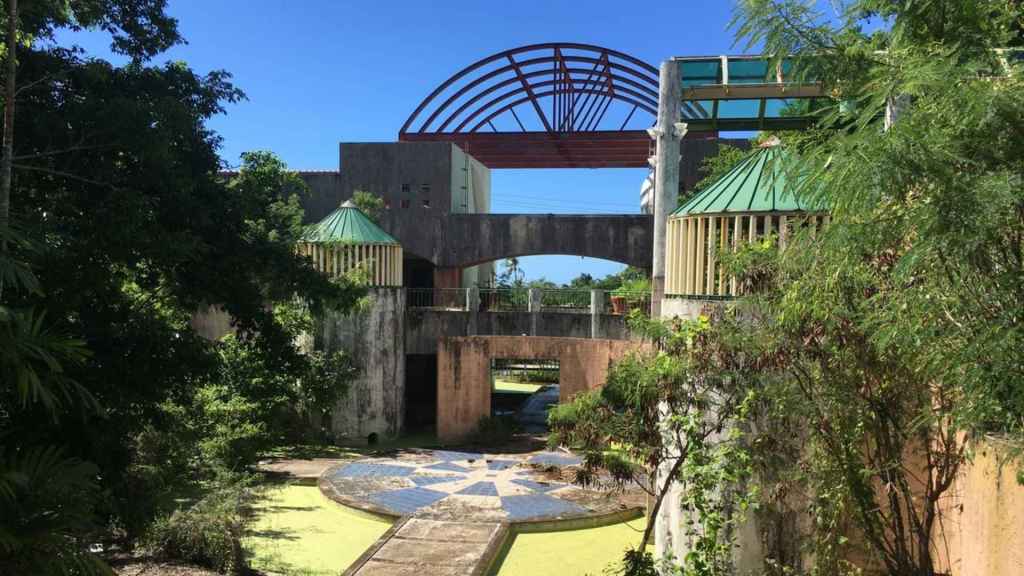
Two days later, agents followed a faint cell-tower ping to San Roque, where the jungle has nearly swallowed an abandoned shopping complex called La Fiesta Mall. It had once been the pride of the island—three wings of bright storefronts and restaurants built for tourists from Japan. Now it stood hollow and silent, its parking lot cracked, the painted letters fading under vines.
The agents parked near what used to be the main entrance. Inside, the air was heavy with the sour smell of heat and rot. They switched on flashlights. Bare footprints marked the dusty tile, small and narrow, leading deeper into the corridor. Drag marks ran alongside them—two parallel streaks through the grime, speckled with brown stains. The trail ended at a door half-open to the women’s restroom.
The power had long been cut. The room was pitch black. In the beam of the flashlights, the outline of a body appeared against the far wall, seated upright, legs extended. Black leggings were tied around her neck in a double loop, the ends tucked neatly beneath the knot. Her face was slack and bruised; her arms and legs were covered in patterned contusions—more than twenty in all, shaped like knuckles. Abrasions ringed her wrists and ankles, faint but clear, as if zip ties had been cut away. The investigators noted the position of the body, the absence of a blood pool, the drag marks leading in. She had been killed elsewhere, then placed here.
The autopsy confirmed ligature asphyxiation. There were fractures in the cartilage of her throat, bruising along her skull from blunt impacts, and internal bleeding that suggested a prolonged fight. The pathologist wrote that she “fought valiantly.” DNA recovered from the sexual assault kit led to Joseph Acosta Crisostomo, a local man with a record for theft and violence. Cell-tower data placed him near La Fiesta at the time of the 911 call. A witness later recognized his voice on the recording.
In his car, investigators found strands of Emie’s hair tangled in the upholstery and fibers from the leggings around her neck. He had rented the same sedan seen idling outside her apartment and tried to sell her missing BlackBerry days later.

In April 2014, a jury convicted him of first-degree murder, kidnapping, sexual assault, and robbery. He was sentenced to life in prison without parole. His appeal failed eight years later.
When it was over, Emie’s family brought her home to the Philippines. They buried her near her parents’ house, the coffin draped in white. Her mother said she wanted her daughter to rest in soil that remembered her. At Godfather’s, her friends pooled money for the flight and sent flowers instead of farewells.
La Fiesta Mall still stands, its empty halls echoing when the wind rushes through. Tropical vines coil through the broken skylights, roots splitting the tiles. Locals avoid the place; the air inside feels wrong, as if it remembers too much.
At Godfather’s, the band still plays past midnight. The regulars laugh, glasses clink, and the ceiling shakes with bass. But every now and then, when the crowd thins and someone wipes down the bar where she once stood, the room falls quiet—just for a moment—before the next song begins, and the night carries on without her.


 Deep Lore